

Don't Trust Us
Aemula Media Spotlight - 5.7.26
We should fix this:
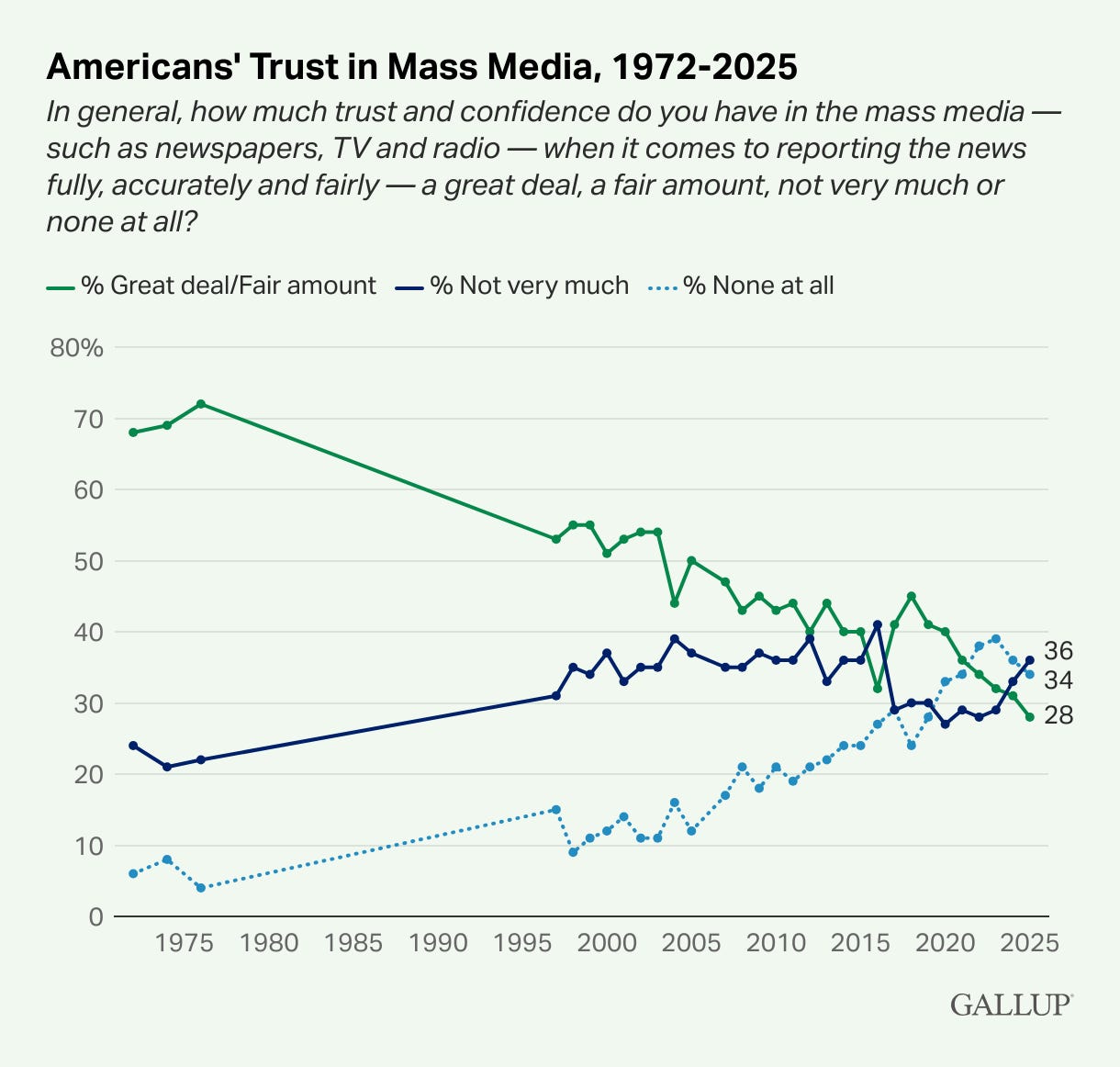
Trust in our news sources has been declining steadily since the 70s. To reverse this trend, rather than attempting to rebuild trust in mass media, what if we developed a form of mass media that didn’t need to be trusted? To determine if that is possible (or what that even means), we need to understand the factors that have contributed to the declining trust in media in the first place.
This is part of the broader trend of trust erosion across society. The Trust Foundation outlines this in detail in their series on the Trust Apocalypse, which we highly recommend.

But to focus on media, specifically news, we need to question how our current institutions rose to prominence. We wouldn’t want GK Chesterton to start lecturing us about fences.
The “news” is really just information about our world that we did not experience directly. Outside of our immediate communities, we rely on strangers to report the news.
We incorporate this information into our worldviews, and it becomes the foundation for the personal beliefs that guide the choices we make. Given the critical function of the news, we need to ensure that it is accurately reported from trusted sources. If not, our misunderstandings can have destructive consequences as they affect the emergent behavior of society.
Historically, our institutional publications served as the trusted intermediaries in this process. They vetted sources, confirmed facts, and curated impactful stories, which they packaged and sold at scale. Our money was well-spent, since we became more informed as a result, and we were able to collaborate more effectively across the globe. As these intermediaries of information built track records of reliable reporting, they earned reputations of credibility. As they gained our trust, they also gained a larger audience.
Larger audiences meant more money, providing those newsrooms with more resources to reinvest into more support for journalists and more distribution. The best journalists competed to earn a role at these institutions to be able to conduct the best reporting, signal the value of their work through association with the institution’s brand, and get their message in front of as many people as possible.
This created a positive feedback loop based on trust, improving both the quality of journalism and the access readers had to new information.
However, reliance on trust is fickle business. This vague method of credibility accounting is at the whim of public opinion. We placed our trust in these institutions based on our faith in their ability to continue reporting the news honestly. But faith is fleeting, and public opinion can be quick to turn. Trust is difficult to earn and easy to lose (as it should be).
During the period between the mid-70s and the early 2000s, we saw two major shifts that disrupted our ability to rely on trust in institutions to drive the positive feedback loop of high-quality journalism.
First, we witnessed the transition into the Information Age. Historically, news publishers and broadcast networks controlled the methods of information distribution. The infrastructure to print and deliver daily papers or broadcast radio and TV was expensive to build, operate, and license. This created a barrier to entry, restricting distribution into the hands of a few major institutions. It was difficult for the average person to get a message in front of millions of viewers.
As the internet became widely adopted, access to distribution was democratized. With the open infrastructure of the internet, as well as the decreasing costs of transmitting information, more people could participate in spreading the news. Almost anyone could get their opinions in front of a large audience, meaning that institutional publications had lost their defensible moat of distribution. Instead, they were forced to compete for attention in the crowded modern media environment. More competition meant lower margins, but quality reporting is expensive to conduct. The only way major publications could stay in business was to consolidate even further, relying on economies of scale to drive down costs.
While mass media was becoming more centralized, audiences were discovering that there was much more nuance to the narratives they had been hearing. We now had the tools to coordinate ourselves into niche communities, learning new information from forums and blogs and independent creators. Was it credible information? Who knows. But we began to circumvent the institutional narratives being spun, breaking the illusion of trust we once held.
The second shift came with the end of the Fairness Doctrine in 1987, an FCC policy that required licensed broadcasters to cover issues of public importance and provide reasonably equal airtime to contrasting points of view. While this sounds good in theory and worked to an extent, the result was an oversimplification of the national narrative. It is impossible to present all of the relevant points of view on every relevant topic within the time constraints of a single broadcast. Instead, the narrative was constrained to binary debates on a select few topics of interest. The simplicity was easy for audiences to follow, making it seem as if we had a grasp of the world around us, but the reality was that we just didn’t have access to all the information. Ignorance was bliss.
Even this narrative we are spinning now is an oversimplification. There were countless contributing factors to the decline of trust in media, and it would be impossible to unravel the full sequence of events if we wish to publish this today. However, both of these shifts played a meaningful role in fragmenting our ideological communities, leading us to question the trust we once placed in mass media. Without trust, the positive feedback loop necessary to drive the success of our institutional publications unraveled.
This is a good thing.
The trust and cohesion once held by mass media was simply an illusion due to oversimplification. We need more nuance. We need more complexity. It allows us to form a better understanding of reality. Though, it is understandably jarring to peek behind the curtain and see all of the problems we face in full resolution.
The period of collapsing trust has been a paradox. Information is cheap and abundant. We can communicate efficiently across vast distances and different languages. We have the tools to develop a more cohesive vision of reality. If our conflicts are all just a misunderstanding, then we can surely leverage this newfound knowledge to come to a collective consensus. Yet, we have only become more polarized as we voluntarily sort ourselves into smaller, increasingly disparate groups.
Fortunately, we have used this period of time to observe and learn from the flaws in our current system. Over the past decade, we have developed new technology to build internet-scale systems of coordination that do not rely on trust. Rather than placing blind faith in centralized intermediaries, trustless systems provide each individual with verifiable proof. We no longer need intermediaries because we can observe credibility directly. We have full transparency into how the system operates. Everyone plays by the rules because it is impossible to break them. They are written in code and executed in the open.
Institutional publications served as a trust layer for news curation and distribution. Trust is now obsolete. We can coordinate the same professional-grade newsroom resources in a collaborative environment, achieving infinite economies of scale without hitting the bottleneck of oversimplification due to consolidation. Where the positive feedback loop driving high-quality journalism was once built on collective trust, it is now built individual incentives.
Using these tools, we can confidently explore the full nuance of the world around us. We don’t have to outsource the development of our worldviews to the institutions once tasked with curating our information environment. We can see everything with our own eyes.
This is why we built Aemula as a trustless system. We don’t need to ask you to have faith in the credibility of the information we share. We don’t even need to prove it. You can verify it independently.
This week, we highlight writers discussing trust in media and the contributing factors to its decline. We encourage you to explore their work and consider subscribing directly.
Requests for Reporting
We are building out new features to allow our community to create requests for reporting, which serve as bounties to incentivize independent journalists to report on under-covered stories of interest.
Comment or message to submit a request
Requests for Reporting will be included here each week
Publish an article on a requested topic through Aemula to earn a bounty
Media in the Media
Trend: Is the traditional media playbook of consolidation running out of steam as demand for independent media and reduced site traffic from AI search results affects the landscape?
James Murdoch in Talks to Buy Vox’s New York Magazine and Podcast Division— The Wall Street Journal
James Murdoch, son of Rupert Murdoch who controls News Corp (parent company of The Wall Street Journal and Fox), is said to be in advanced talks with Vox Media to purchase their New York magazine and podcast division through his Lupa Systems investment company.
This comes after Vox Media announced they would be unwinding part of their media portfolio. They had acquired New York Magazine as part of an all-stock merger transactions with New York Media in 2019.
Vox’s decision to unwind their media portfolio is driven by decreasing site traffic and advertising revenue as they face increasing competition from the new wave of independent lifestyle publications and reduced page visits from search engine results due to new AI summaries.
Lupa Systems (stakes in Tribeca Film Festival, Art Basel, and The Bulwark) will need to compete with Versant Media Group (spin-off of Comcast, parent to MS NOW, CNBC, USA, E!, Rotten Tomatoes, Fandango, and more) for interest in Vox’s podcast business (Kara Swisher and Scott Galloway’s “Pivot”, Brené Brown’s “The Curiosity Shop”, Adam Grant and Maria Sharapova’s “Pretty Tough”, and more).
Vice News Is Being Resuscitated With Fresh Ambitions — The Hollywood Reporter
“equal parts creator-driven news outlet and brand partnership vehicle”
Not hiring additional staff, but instead it seems like they will be platforming existing content creators
Soft brand relaunch on Wednesday with a new Vice News site
Writer Spotlight
Let’s Address This
Written by Qasim Rashid, a human rights lawyer and author whose work draws on more than a decade of advocacy to provide clear, evidence-based analysis of pressing human rights issues, amplifying marginalized voices, and holding power accountable.

“The newsrooms that once covered city council meetings, school board decisions, local elections, and the stories that directly shaped people’s daily lives have been gutted, consolidated, or eliminated entirely.
Into that vacuum have stepped billionaires—purchasing media outlets not to inform the public, but to protect their interests, sanitize their reputations, and shape the information environment in ways that serve their bottom line. I have written about this in detail before. The pattern is unmistakable and the consequences are severe.
But something else has also stepped into that vacuum. Something the billionaires did not anticipate and cannot fully control.
Independent media.”
New Cartographies
Written by Nicholas Carr, a bestselling author and Pulitzer Prize finalist whose work examines the impact of technology on society, drawing on decades of writing for outlets like The Atlantic, The New York Times, and The Wall Street Journal to explore the intersection of technology, business, and culture.

In 1919, Lippmann wrote a despairing essay in the Atlantic Monthly titled ‘The Basic Problem of Democracy.’ Democracy’s founding ideal—that of a well-informed citizenry capable of making reasoned judgments about national problems and plans—had come into being in a much simpler time, he argued, when most concerns were local and people had direct experience of them. The assumptions of America’s founders, a small, insular, largely agrarian elite, held little relevance to the bustling modern world, with its urban and industrial energies and lightning-quick communications. Society was much more complex now, and people’s sense of it came not from their own first-hand observations but through information received ‘at second, third, or fourth hand.’”
The Pugilist
Written by Alisa Valdes-Rodriguez, an investigative journalist and former staff writer for The Boston Globe and Los Angeles Times, whose work spans literary nonfiction and fiction to examine culture, politics, and everyday life with an emphasis on depth, context, and understanding.

“The institutions you grew up trusting have been hollowed out and replaced by something that serves a very different set of interests, follows a very different set of incentives, and produces news that is not neutral, not comprehensive, and not, in any meaningful sense, free. This was by design. It is not that the press isn’t doing their job, as so many seem to think. It’s that the press was killed and some of you keep expecting it to breathe.”

Did you catch the change in the subtitle? “Media” spotlight instead of “writer” spotlight? We experimented with some new sections to cover the media industry more broadly while still spotlighting independent writers. Let us know what you think.
Are you writing on Substack? You can easily set up automatic cross-posting with Aemula to instantly:
Increase your earnings
Expand your audience
Verifiably own your work
Plus, you will have opportunities to access community resources and grants to support the content you want to create!
Link your Substack to your Aemula account using this link or reach out to writers@aemula.com to get started!
No cost, no obligations, and you can stop at any time.
If you want to support any of the writers we spotlight in our Substack, we highly encourage you to subscribe to their individual publications.
If you want to support independent journalism more broadly, create an account on the Aemula platform.
To stay up to speed on platform updates and the writers we are adding to our community, Follow us on X or subscribe to our Substack!
Any writers you want to see featured here? Send them our way! We are always searching for great new publications.
